Download PDF via DOI:
https://doi.org/10.51480/compress.2025.8-2.993
Wizualne reprezentacje NATO na Instagramie: dyplomacja publiczna i budowanie wizerunku instytucjonalnego
Visual Representations of NATO on Instagram: Public Diplomacy and Institutional Image Building

Abstrakt
Abstract
Keywords
- digital communication, dyplomacja publiczna, image management, instagram, komunikacja cyfrowa, miękka siła, NATO, public diplomacy, soft power, zarządzanie wizerunkiem
INTRODUCTION
Since the end of the Cold War, NATO has operated in a shifting geopolitical landscape that has required adaptation in its roles, missions, and communication practices. In this context, the Alliance engages with diverse audiences, including publics in non-member states. At the same time, developments in digital media have transformed how information related to security and international affairs circulates globally.
Social media platforms function as spaces in which representations and narratives related to international actors can be observed. Seib (2012) notes that contemporary diplomacy operates in real time through social media platforms, moving beyond traditional closed-door interactions. Public diplomacy increasingly takes place on digital platforms, where visual content shapes how international organizations communicate with global audiences. Institutional image in visual communication is not constructed through isolated visuals, but through repeated patterns and themes across shared content. Over time, these patterns contribute to a recognizable visual style shaped by the selection of settings, actors, activities, and symbolic elements. Visual representations contribute to how institutions imagine themselves and define the boundaries of their public identity (Schlag, 2025). Instagram, as a visually oriented platform, enables institutions to share images and short videos that convey identity, values, and institutional presence through visual content. Within studies of international organizations, visual communication on social media has been examined as part of broader representational practices. Through such visual and narrative representations, organizations such as NATO present selected events in a simple and accessible format.
While existing research has often approached NATO’s social media communication through perspectives such as language use and mediatization, less attention has been directed toward the visual dimension of its online presence. This observation is particularly relevant for visually oriented platforms, where images constitute a primary mode of communication and representation. NATO maintains an active presence on Instagram, where it regularly shares visual content through posts and reels. These visuals include images related to institutional activities, alliance cooperation, and organizational representation. As an international security alliance traditionally associated with formal and strategic modes of communication, NATO’s use of a visually oriented platform such as Instagram provides a relevant context for examining how institutional image and alliance identity are visually presented within the framework of public diplomacy. Within the context of public diplomacy, visual communication also offers a way to examine how international organizations present themselves beyond formal statements and policy documents. As such, the analysis of visual representation can contribute to understanding how institutions construct and sustain their public image in online environments.
This study examines how NATO uses Instagram as a platform for visual communication in public diplomacy. Focusing on posts and reels shared on NATO’s official Instagram account, the study analyzes recurring visual themes and symbolic elements identified through qualitative content analysis. The study provides a structured examination of how visual content contributes to the representation of NATO’s institutional image and alliance identity on social media. In line with this objective, the analysis seeks to identify the dominant visual themes characterizing NATO’s Instagram posts during the selected period. It further examines how military and peaceful narratives are constructed through visual representation and determines which framing patterns are most frequently employed in the organization’s Instagram communication.
Literature Review
Public Diplomacy and Social Media
Public diplomacy refers to the ways in which states and international actors communicate with foreign publics in order to shape perceptions and representations. Joseph Nye’s (2004) concept of soft power is frequently referenced in discussions of public diplomacy that focus on culture, values, and communication practices. Public diplomacy is therefore not limited to states, but also involves international organizations such as NATO, which engage with foreign publics through various communication channels. Developments in digital technologies and social media have significantly reshaped the practice of public diplomacy. The concept of digital diplomacy refers to the strategic use of digital and social media platforms in diplomatic communication. As Sabrina Sotiriu (2015) argues, digital diplomacy builds on the foundations of soft power and public diplomacy while adapting these concepts to digital tools and online engagement. Rather than replacing traditional diplomacy, it extends its logic into networked and interactive environments.
Similarly, Corneliu Bjola and Lu Jiang (2015) note that diplomatic “presence” was traditionally maintained through mass media, cultural initiatives, and educational exchanges. However, the emergence of social media has expanded this presence beyond physical and temporal boundaries, enabling states and international actors to remain visible and continuously engaged in digital spaces. They also emphasize that the interactive nature of social media creates opportunities for sustained dialogue between diplomats and foreign publics. This two-way communication allows policymakers to adjust their messages, address misinformation, and foster deeper mutual understanding. Therefore, social media supports the goals of public diplomacy in ways that differ from conventional one-way communication methods. Manor (2019) suggests that social media offers unique opportunities, particularly when states and international organizations craft their narratives during a crisis. Instagram is often discussed as a visually oriented platform that enables the sharing of symbolic and image-based content.
NATO’s Social Media Use and Image Management
Public diplomacy is increasingly practiced through social media platforms. In this context, policymakers must consider not only domestic public opinion but also the expectations of international audiences and foreign governments (Di Martino, 2020). This transformation has made digital platforms central spaces where states and international organizations communicate their values, policies, and institutional identities. Previous studies have examined NATO’s use of social media in relation to institutional communication and image representation. Research has shown that social media platforms provide opportunities to observe how NATO presents its activities and organizational identity in digital environments (Arendarska, 2017). In this context, visual content shared by organizations such as NATO becomes a relevant source for examining patterns of representation and image-related communication practices. Building on this literature, the present study focuses on NATO’s use of Instagram as a visually oriented platform. By examining the visual content shared through posts and reels, the study contributes to existing research by offering a focused analysis of how NATO’s institutional image and alliance identity are visually represented on social media.
Methodology
This research used qualitative content analysis to examine how visual content (posts and reels) shared on NATO’s Instagram account contributes to image management in the context of public diplomacy. The sample includes all 50 posts and reels published consecutively on NATO’s official Instagram account between 13 May and 18 June 2025. No selective filtering was applied. Including all visual content shared during this consecutive period ensured methodological transparency and minimized researcher bias in sample construction. The selected timeframe was not linked to a specific political event. Instead, it represents a continuous and routine communication period. This approach allows the study to examine NATO’s everyday visual communication practices rather than content shaped by extraordinary crises or summit-driven communication spikes. The posts were systematically examined and analyzed according to dimensions such as visual narrative, theme, and message structure for the target audience. During the analysis, the content was evaluated using coding categories informed by Gillian Rose’s (2016) framework in Visual Methodologies: main topic, communication strategy, persuasive strategy, media type, target audience, visual focus, visual tone, main visual element, and main focus. The coding process was carried out manually, and each post was analyzed separately according to these categories. Qualitative data were handled using an interpretive approach to evaluate the strategic framework in which the content was produced and the kind of discourse it created. This methodological approach was structured in line with the theoretical framework of the study on public diplomacy, the use of soft power, and institutional image management. NATO’s presence on the digital platform was considered not only as informative content, but also as a communication practice that aims to establish legitimacy through strategic messages.
Figure 1. Visual representation of the methodology.
| Coding Categories | Subcategories | Theoretical Foundation |
|---|---|---|
|
Main Topic |
Military Readiness, International Cooperation, Political Declarations, Commemoration, Peacekeeping, Defence Production |
Thematic Analysis – “What is represented?” |
|
Communication Strategy |
Informative, Justification, Solidarity |
Strategic Meaning Construction |
|
Persuasive Strategy |
Authority, Trust, Emotional Resonance, Collective Identity |
Visual Rhetoric and Institutional Appeals |
|
Media Type |
Photo, Reel |
Technical Composition and Format |
|
Target Audience |
General Public, Partner Nations, Media, Internal Stakeholders |
Audience Positioning |
|
Visual Focus |
Military Personnel and Equipment, Political Leaders, Symbolic Objects | Compositional Focus and Spatial Hierarchy |
|
Visual Tone |
Peaceful, Defensive, Militarized |
Emotional Effect Intended for the Viewer |
| Main Visual Element | NATO Flag, NATO Logo, Military Uniforms, Aircraft, Unity, Partner Flags |
Dominant Symbolic Representation |
Coding Procedure
Example 1 – 18 May 2025 Post
The post dated 18 May 2025 was coded according to predefined operational criteria applied consistently across the dataset. Each post was assigned to a primary category based mainly on its dominant visual emphasis. The main topic was classified as Military Readiness because the caption explicitly refers to a joint training mission, airspace protection, and deterrence posture. These indicators align with the operational definition of preparedness and active defense activity. The communication strategy was coded as Informative because the caption provides descriptive information without strongly evaluative or persuasive language. The persuasive strategy was identified as Trust because the wording emphasizes reassurance, protection, and institutional reliability. The media type was Photo. The visual focus was coded as Military Equipment, as aircraft occupy the central compositional position. The main visual element was Partner Country Flags, which appear alongside the aircraft and signal alliance representation. The visual tone was coded as Defensive because the framing highlights protection and deterrence within a security context.
Example 2 – 2 June 2025 Post
The post dated 2 June 2025 was coded using the same predefined decision rules applied across the dataset. The main topic was classified as Political Declaration because the caption centers on policy commitments, defense investment, and collective defense decisions made at the NATO Summit. According to the operational criteria, posts were coded under Political Declaration when official statements, summit outcomes, or policy reaffirmations constituted the dominant emphasis. The communication strategy was coded as Justification because the caption explains and legitimizes increased defense investment. The persuasive strategy was identified as Authority due to the visual and textual prominence of the Secretary General as an institutional representative. The media type was Reel. The visual focus was coded as Political Leader, as the Secretary General occupies the central frame. The visual tone was identified as Defensive because the message emphasizes collective defense and security challenges.
FINDINGS
Main Topic
Figure 2. Distribution of NATO’s Instagram Posts by Main Topic.
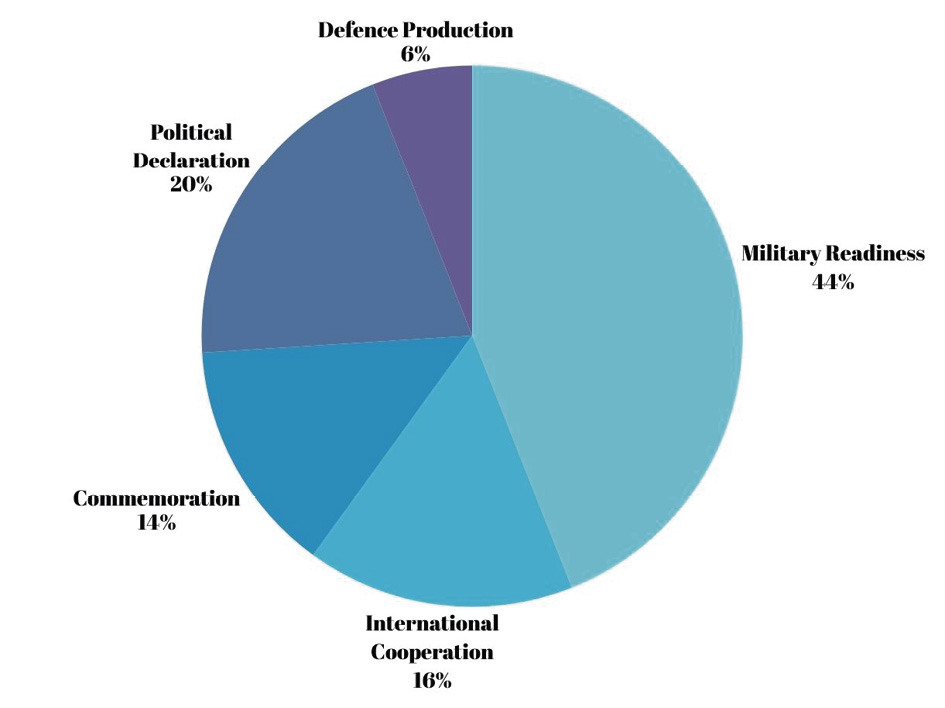
Military Readiness constitutes the largest category, accounting for 44% of the sample. This proportion indicates that nearly half of the analyzed posts center on operational and defense-oriented themes. Political Declarations (20%), International Cooperation (16%), and Commemoration (14%) follow at comparatively lower levels, while Defense Production remains marginal at 6%.
Persuasive Strategy
Figure 3. Distribution of Persuasion Strategies Used in NATO’s Instagram Content.
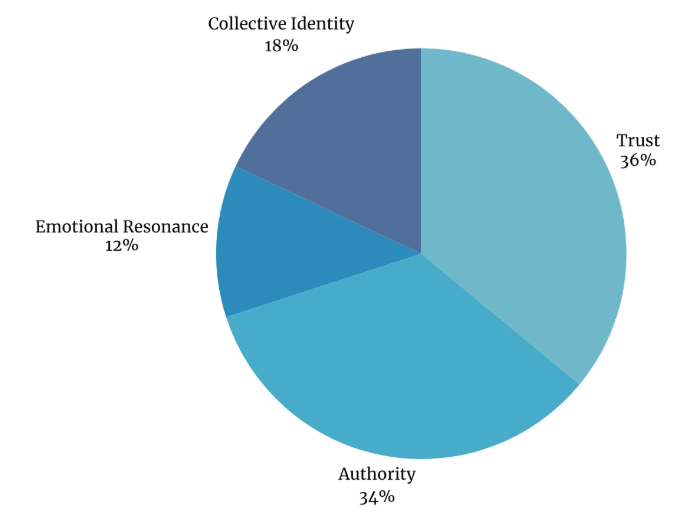
This chart shows the distribution of persuasion strategies used in NATO’s Instagram content. Trust is the most frequently used strategy, appearing in 36% of the content. It is followed by authority at 34%. Collective identity ranks third at 18%, while emotional resonance appears in only 12% of the analyzed content.
Media Type
Figure 4. Distribution of Media Types in NATO’s Instagram Content.
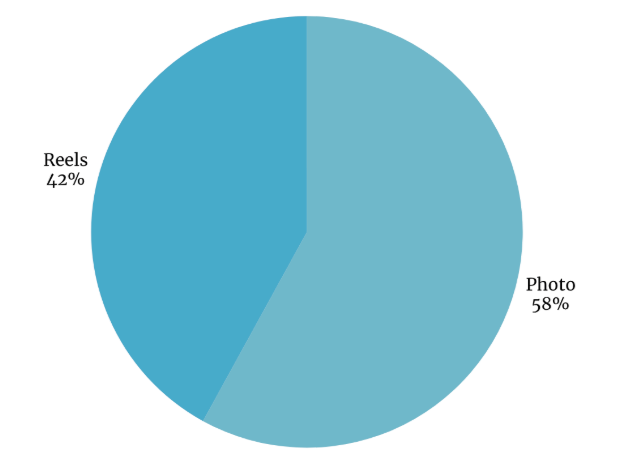
The figure presented above illustrates the distribution of media types used in the analyzed NATO Instagram content. In the sample, 58% of the posts were photos, while 42% were shared as reels (short videos). The distribution reflects media usage within the selected research period and should not be interpreted as representative of NATO’s overall Instagram strategy.
Visual Focus
Figure 5. Distribution of Visual Focus Points in NATO’s Instagram Posts.
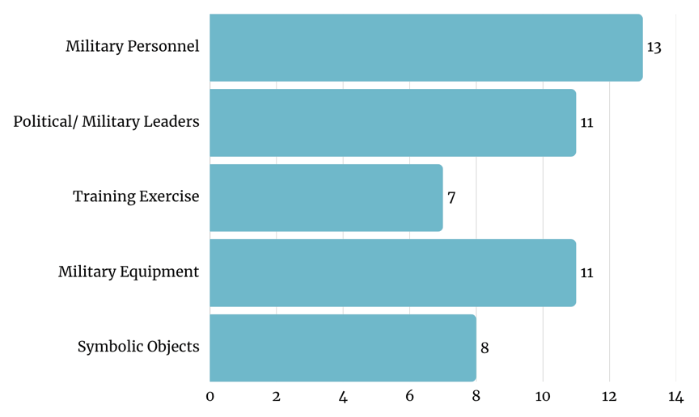
The visual representation outlines the most prominent visual focus points in the analyzed posts. The most frequent visual focus is military personnel, which appeared in 13 posts. Military/political leaders and military equipment ranked second, with 11 posts each, while training exercises were highlighted in 7 posts. Symbolic objects were more limited, appearing in 8 posts.
Visual Tone
Figure 6. Distribution of Visual Tones in NATO’s Instagram Posts.
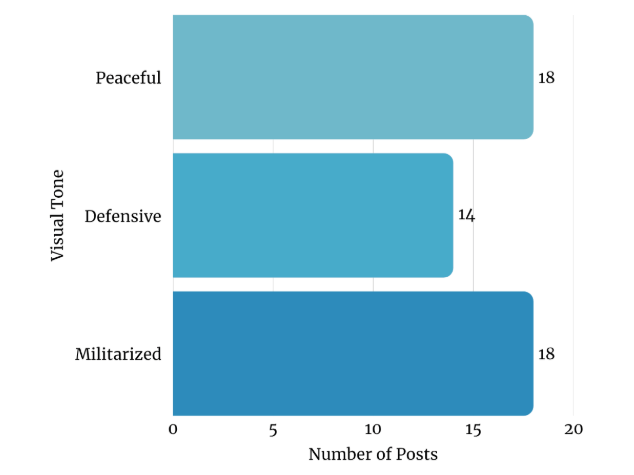
This figure presents the distribution of visual tones identified in NATO’s Instagram posts. Militarized and peaceful tones appear with equal frequency (18 posts each), indicating a symmetrical presence of contrasting visual atmospheres within the sample. Defensive imagery appears slightly less frequently (14 posts), yet it remains a significant component of the overall visual composition.
Visual Element
Figure 7. Distribution of Key Visual Elements in NATO’s Instagram Posts.
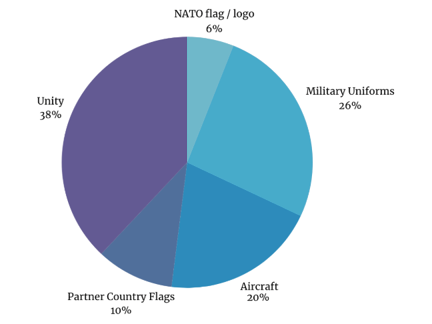
This chart illustrates the distribution of the main visual elements found in the analyzed Instagram content. Images related to unity appeared most frequently (38%), followed by military uniforms (26%) and aircraft (20%). The NATO flag/logo was the least prominent element, accounting for only 6% of the images.
Communication Strategy
Figure 8. Distribution of Communication Strategies Used in NATO’s Instagram Posts.
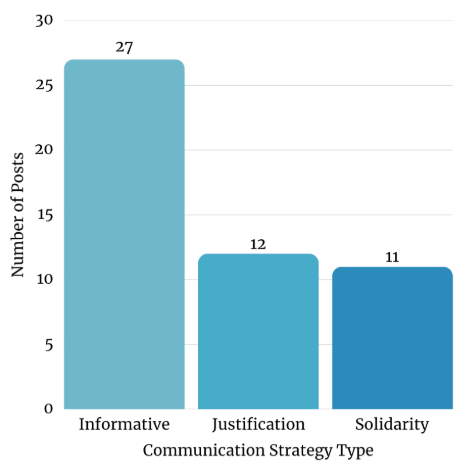
The visual data show the distribution of communication strategies used in the analyzed NATO Instagram posts. The most frequently used strategy was informative content, which appeared in 27 posts in total. The justification strategy was used in 12 posts, and the solidarity strategy was used in 11 posts.
Target Audience
Figure 9. Frequency of Target Audience Mentions in NATO’s Instagram Content.
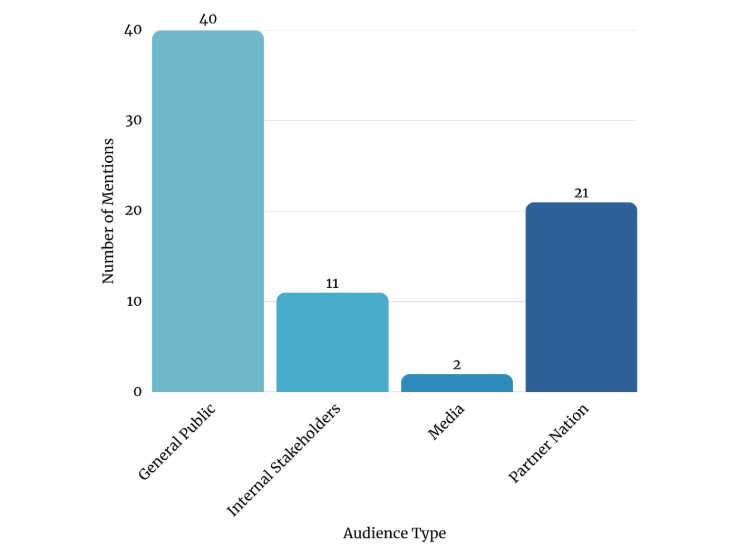
The analyzed content shows that the general public is the most frequently targeted audience in NATO’s Instagram communication. This indicates that the organization aims to inform and raise awareness among broader publics as part of its public diplomacy efforts. A significant portion of the content is also directed at partner countries, reflecting NATO’s tendency to reinforce messages of solidarity and unity with its allies in the digital environment. The number of posts targeting international stakeholders was relatively limited, with the media directly addressed in only two posts.
DISCUSSION
The findings indicate a structured pattern in NATO’s Instagram communication, in which military readiness occupies a central position alongside authority and trust as dominant persuasive elements. The frequent appearance of personnel, uniforms, and equipment underscores operational capability and preparedness. At the same time, unity symbols, commemorative posts, and cooperation themes appear consistently, showing that security narratives are presented together with messages of solidarity and collective identity.
From a framing perspective, the results suggest an integrated communication structure in which security, unity, and legitimacy function as interconnected dimensions. The coexistence of militarized, defensive, and peaceful visual tones reinforces this interpretation. NATO’s Instagram content brings together images of deterrence and preparedness with references to cooperation and shared values. This combination reflects a form of digital public diplomacy that connects security discourse with identity construction.
The prominence of trust and authority as persuasive strategies strengthens this institutional positioning. Leadership figures, official statements, and coordinated exercises foreground credibility and expertise. Emotional resonance appears less frequently, indicating that persuasion operates primarily through institutional legitimacy and structured messaging. The recurring presence of unity-centered imagery further situates these messages within a cooperative international context. The preference for photo posts over short-form videos also supports this interpretation. Static images provide visual clarity and symbolic stability, allowing messages to remain consistent across posts. This consistency contributes to the construction of institutional continuity and authority within the digital environment.
Taken together, the findings illustrate how NATO integrates security representation, unity discourse, and persuasive authority into a coherent communication approach on social media. The study does not examine audience reception or impact. It focuses on communication patterns and explains how visual and verbal elements shape institutional image online.
CONCLUSIONS
The analysis of NATO’s Instagram posts indicates that the organization integrates both military and diplomatic elements into its digital communication. Military exercises, personnel, and equipment are prominently featured, while commemorative content and political declarations highlight themes of cooperation and international solidarity. The findings show that informative messaging is the dominant communication style, accompanied primarily by persuasive strategies based on authority and trust.
The visual and textual patterns identified in the sample suggest a structured use of framing mechanisms. Security-related visuals emphasize deterrence and operational readiness, whereas solidarity and unity themes are communicated through representations of joint exercises, national symbols, and diplomatic events. These patterns demonstrate how NATO constructs its institutional image through digital platforms.
However, this study does not assess the effectiveness or audience impact of these communication strategies. Rather, it provides a descriptive analysis of the visual and discursive tools employed in NATO’s Instagram content. By systematically categorizing visual and verbal patterns, the study offers an empirical mapping of how institutional narratives are constructed on social media. In doing so, it contributes to the growing body of literature on digital public diplomacy and institutional image construction in online environments. Future research could expand the scope by examining audience engagement metrics, comparative institutional analyses, or cross-platform communication strategies.
REFERENCES
Arendarska, J. (2017). NATO as an actor of political communication. Political Preferences, 17. https://journals.us.edu.pl/index.php/PP/article/view/6140
Bjola, C., & Jiang, L. (2015). Social media and public diplomacy: A comparative analysis of the digital diplomatic strategies of the EU, US, and Japan in China. In C. Bjola & M. Holmes (Eds.), Digital diplomacy: Theory and practice. Routledge. https://doi.org/10.4324/9781315730844–6
Di Martino, L. (2020). Conceptualising public diplomacy listening on social media. Place Branding and Public Diplomacy, 16, 131–142. https://doi.org/10.1057/s41254–019–00135–5
Manor, I. (2019). The digitalization of public diplomacy. Palgrave Macmillan. https://doi.org/10.1007/978–3-030–04405–3
Nye, J. S. (2004). Soft power: The means to success in world politics. PublicAffairs.
Rose, G. (2016). Visual methodologies: An introduction to researching with visual materials (4th ed.). SAGE.
Schlag, G. (2025). The look of NATO: Comparing visual representations of military force and alliance identity in 1984 and 2021. European Journal of International Security, 10(4), 589–610. https://doi.org/10.1017/eis.2024.56
Seib, P. (2012). Real-time diplomacy: Politics and power in the social media era. Palgrave Macmillan. https://doi.org/10.1057/9781137010902
Sotiriu, S. (2015). Digital diplomacy: Between promises and reality. In C. Bjola & M. Holmes (Eds.), Digital diplomacy: Theory and practice (pp. 33–51). Routledge. https://doi.org/10.4324/9781315730844–4