Download PDF via DOI:
https://doi.org/10.51480/compress.2025.8-2.922
Wizerunek Stanów Zjednoczonych Ameryki w "Kuensel" - najpopularniejszej gazecie Bhutanu
Perception of America in "Kuensel" - Bhutan’s most popular newspaper

Abstrakt
Abstract
This paper explores the image of the United States of America in Bhutan’s most popular newspaper. The Kingdom of Bhutan is a Buddhist country in the Himalayas that for centuries remained in self-imposed isolation, which influenced its culture, customs and media, introduced only at the end of the 20th century. This constitutional monarchy is governed according to the Gross National Happiness (GNH) index, which measures development not only in monetary terms, but also through citizens’ well-being and personal fulfillment. These distinctive circumstances have shaped Bhutanese media, which tend to avoid harsh judgments, sensationalism and tabloidization; for this reason, the presentation of the United States through a Bhutanese lens is particularly interesting. The study is based on a qualitative paradigm and uses media content analysis. The research sample consisted of 122 texts published in Kuensel. The authors used MAXQDA, a leading software package for qualitative and mixed-methods research, as their analytical tool. The results address a research gap concerning the image of America in Bhutanese media.
Keywords
INTRODUCTION
Bhutan is a small landlocked country in South Asia, in the eastern Himalayas, bordering China to the north, west and east, and India to the south. In Bhutanese culture the country is referred to as Druk Yul, meaning “Kingdom of the Dragon”. The people of Bhutan call themselves Drukpa. Due to its mountainous terrain, Bhutan long remained relatively resistant to external cultural influences. For a long time, a policy of strict cultural and economic isolationism was maintained in order to preserve the country’s heritage and distinctiveness. Until the final decades of the 20th century, only a few foreigners were allowed to visit Bhutan, which helped the country preserve its traditions and customs.
Bhutanese media are a relatively new subject of scholarly exploration. Although there are many works describing the internal development of Bhutanese media, there are still relatively few theoretical approaches to their analysis.
Bhutan remained in self-imposed isolation until China annexed neighbouring and culturally similar Tibet in the 1950s (Conlon, 2002). In response to this threat, Jigme Dorji Wangchuck, King of Bhutan, decided to modernize his kingdom. He introduced reforms that eventually led to democracy in 2008 (Shaw, 2013). The media have played a crucial role in establishing democracy and keeping it accountable (Muppidi, 2012). Moreover, the history of Bhutanese media is quite recent: it began with the government bulletin Kuensel in 1967, which was later transformed into an independent, although government-financed, newspaper (Żyliński, 2016). Radio was introduced in 1973, and television and the internet in 1999 (Rapten, 2001). With the advent of democracy in 2008, private media were eventually allowed to operate, creating a counterbalance to state-sponsored outlets; nevertheless, due to financial difficulties, private initiatives have struggled to compete with public ones.
Kuensel holds a special place in Bhutan’s media history as its first and flagship newspaper. The name Kuensel means “clarity” or “clear light” in Dzongkha, reflecting its founding mission to disseminate information across the kingdom. Established in the 1960s as a government information bulletin, Kuensel gradually evolved into a weekly newspaper by the 1980s. In 1992, a royal edict formally de-linked Kuensel from direct government control, transforming it into an autonomous corporation as part of Bhutan’s media modernization. Nevertheless, the government retained a majority stake, and even after partial privatization Kuensel remained majority state-owned (51% government, 49% public). For decades it was Bhutan’s only regular newspaper, published in both Dzongkha and English, and it continues to enjoy nationwide reach and influence. This origin narrative – from a state bulletin to an independent daily known as “the clear voice” of the nation – underlines the newspaper’s foundational role in Bhutan’s emerging media landscape (Kuensel Online, 2025; Wood, 2007).
Bhutan’s media environment must be understood in the context of global press freedom indicators, which highlight both progress and persistent constraints. The 2008 constitution guarantees freedom of the press, but in practice Bhutan is rated only “Partly Free” in recent assessments (Freedom House, 2024). In the 2025 World Press Freedom Index, Bhutan ranked 152nd out of 180 countries, reflecting a decline in its press freedom standing. Reporters Without Borders notes that despite formal democracy, self-censorship remains pervasive in Bhutanese newsrooms (Reporters Without Borders, 2025). Many private outlets depend financially on government advertising, which further limits editorial independence. Historically, overt criticism of the monarchy or government was taboo; a mid-2000s Freedom House report observed that Kuensel, then the sole newspaper, “generally reports news that portrays the kingdom positively” and only rarely publishes critical content. Even today, Bhutanese journalists often tread carefully on sensitive issues, in line with cultural norms of respect and social harmony. This cautious media culture helps explain why sensationalism and adversarial reporting are uncommon in Bhutan, and it provides crucial context for how foreign countries – including the United States – are portrayed in Kuensel.
Both local and international researchers have commented on the media sphere of this Himalayan kingdom. In an early description of Bhutanese media, Kinley Dorji states that “Bhutanese society and values are traditionally very democratic, and the people are known for their openness and pragmatism” (Kinley, 1991, p. 3). He also declares that if a social issue is discussed in the media, it is met with “immediate and effective responses from our decision-makers” (Kinley, 1991, p. 4). This was written almost two decades before the introduction of democracy and private media, but the notion remains relevant in the Dragon Kingdom. It is also worth mentioning that English is the primary language of instruction at all levels of education and is widely used in the media. Storytelling is another popular research subject among scholars, including Chandra Shekhar Sharma (2007), who connects this ancient form of transmission to McLuhan’s paradigm (McLuhan & Lapham, 1994): “Each folktale is a medium of communication, and also a process of communication in itself” (Sharma, 2007, p. 87).
Bunty Avieson argues that, in an oral culture such as Bhutan’s, social media platforms such as Facebook and Twitter “sit comfortably alongside more traditional forms of media such as mani stones and lama dancing” (2015, p. 2487). She uses Benedict Anderson’s theory of media and nationhood as a lens for understanding the developing Bhutanese mediascape. Beate Josephi, in her report on journalism in Bhutan (2016), underlines the importance of a free press in the development of democracy, which is a relatively new concept in Bhutanese society because it was introduced in 2008. Doliwa and Żyliński (2021) emphasize the importance of the Gross National Happiness index, which measures social progress not in monetary gains but in terms of human well-being, for the creation and everyday operation not only of community radio but of Bhutanese media in general.
Analyzing Bhutan’s press requires situating it within broader media theory while recognizing the need to adapt those theories to Bhutan’s unique context. Classic normative theories of the press, such as the Four Theories outlined by Siebert, Peterson and Schramm in 1956, were developed around Western and Cold War-era media systems and do not neatly fit the Bhutanese case. In fact, Bhutan’s own media scholars have noted this misalignment: Dorji Wangchuk argues that mainstream “media models postulated under different social, cultural, religious, political, and historical evolutions (…) won’t be fully applicable to Bhutan” (Wangchuk, 2018). He explicitly critiques Western foundational concepts – from Edmund Burke’s Fourth Estate to Siebert et al.’s Four Theories of the Press – as failing to describe Bhutan’s media environment. Likewise, established comparative media-system typologies, such as Hallin and Mancini’s three models, which link media to Western political structures, have limited explanatory power here (Hallin & Mancini, 2004). Bhutan might superficially resemble what Hallin and Mancini call a “polarized pluralist” system, with low newspaper circulation and an elite-oriented press, yet such a classification overlooks indigenous factors such as Bhutan’s Buddhist governance ethos and the influence of Gross National Happiness on media norms. Recognizing these gaps, scholars have called for the de-Westernization of media studies, urging researchers to “critically revisit” Cold War normative framings of media theory and expand analysis beyond Western assumptions (Chakravartty & Roy, 2023). In line with this approach, Bhutanese theorists propose home-grown frameworks such as middle-path journalism, a model grounded in Bhutan’s cultural values of consensus and compassion and inspired by Buddhist principles and GNH. Bringing in these perspectives ensures that this study of Kuensel is not simply forced into Western theoretical molds, but is interpreted through a framework attuned to Bhutan’s social and political context. This theoretical positioning strengthens the analysis by connecting Bhutan’s media experience with global media theory while avoiding a one-size-fits-all application of Western models.
GNH also influences middle-path journalism, a conceptual framework for Bhutanese media developed by Dorji Wangchuk (2018). The framework draws on the philosophy of Gross National Happiness (GNH), a key concept in Bhutan’s socio-political sphere (Ura et al., 2012). It is a four-dimensional model based on community, compassion, commitment and contentment that “strives toward building consensus and communities through a more human-centric approach instead of thriving on conflicts, controversies, and commercialism. A media model such as these could offer a better narrative for a small country like Bhutan” (Wangchuk, 2018, p. 133). Wangchuk eventually claims that other “media models postulated under different social, cultural, religious, political, and historical evolutions (…) won’t be fully applicable to Bhutan” (Wangchuk, 2018, p. 136). He rejects the famous Fourth Estate concept, the basis of Western media, introduced by Edmund Burke (Hampton, 2010); the anti-establishment model adopted by India, which he associates with mistreatment by colonial rulers (Datta-Ray, 1996); the widely cited Four Theories of the Press (Siebert, Peterson, & Schramm, 1956), because in his view it does not describe Bhutanese media; and the theory of the social responsibility of the press by Park and Curran (2000), developed as a response to the atrocities of the Second World War. Lastly, Dorji Wangchuk mentions the Judeo-Christian worldview based on original sin (Wiley, 2002), which in his opinion helps explain negativity in global news. In Himalayan Buddhism, by contrast, all sentient beings have Buddha-nature and are inherently good (Norbu, 2001). Wangchuk provides a concise definition of his concept: “middle path journalism could be defined as a human-centric model that takes into account the values and vision of a country in the practice of media and communication” (2018, p. 138). In our analysis of representations of the United States in Kuensel, we use Wangchuk’s approach to examine whether this concept is reflected in actual reporting.
METHODS
Methodologically, this case study is situated within the tradition of comparative and cross-national media research that examines how nations perceive and portray one another through news. Studies of international news content often show that media representations of foreign countries vary significantly by national context, and they call for more inclusive research beyond the usual focus on large or Western countries. For example, scholars have noted a lack of systematic investigation into how the United States is depicted in Asian media, including the Chinese press (He, Xianhong, & Xing, 2012). Where such studies have been conducted, they reveal nuanced and sometimes contradictory images: one content analysis of Chinese newspapers found the U.S. portrayed as both a democratic ideal and a hypocritical hegemon, among other dualities (He, Xianhong, & Xing, 2012). By analyzing Bhutan’s leading newspaper, this study extends that line of inquiry to a new and under-researched national context, thereby contributing a fresh data point to the comparative media literature on foreign image perception. This research design – a qualitative content analysis of how one country (Bhutan) frames another country (the United States) – follows a well-established cross-national approach to understanding media and soft power. In doing so, the study addresses a gap in media scholarship: it provides insight into the image of the U.S. from the perspective of a small, non-Western media system. Such a perspective enriches comparative media research by adding diversity to the cases studied and by testing whether theories of international news flow and framing hold true in the context of Bhutan’s unique media environment. The emphasis on Bhutan’s context also aligns with the broader push in media and communication studies to broaden the geographic scope of research, ensuring that insights are drawn from “beyond national borders” and outside the traditional Western focus (Chakravartty & Roy, 2023).
The study is based on a qualitative paradigm and uses the media content analysis method (Creswell, 2013, pp. 38-39). The authors chose the analyzed material because it was “telling”, that is, “serving to make previously obscure theoretical relationships suddenly apparent” (Mitchell, 1984, p. 239). The selected phenomena and material were chosen because they “best provide insight into the social phenomenon to be investigated” (Emmel, 2013, p. 74). The research process consisted primarily of analyzing the research sample in order to identify the image of the United States contained within it. During the research process, the researchers took into account the historical, cultural and geopolitical contexts that influence the interpretation of the perception of the United States in Bhutan’s most popular daily newspaper.
The research sample consisted of 122 texts drawn from articles published in Kuensel from 2015 onward, in editions that the authors were able to access. When the following phrases were entered into the search engine on the Kuensel website, the authors obtained a total of 1,984 results: “United States of America” (67), “United States” (301), “America” (268) and “USA” (1,348). By selecting every fifth article, the authors extracted 397 articles. Some of them were duplicates; after these were removed, 168 texts remained. During the content analysis process, certain items were eliminated because they did not concern the United States but included terms such as “United Nations”, “Latin America”, “United Arab Emirates”, “United Kingdom” and “American Samoa”; for this reason, the search engine included them at the source-collection stage. After this selection, 122 articles were eventually included in the research sample.
The authors used MAXQDA, a leading software package for qualitative and mixed-methods research, to organize the resulting categories and analyze the texts in terms of the frequency of selected words.
RESULTS
The curated image of the United States
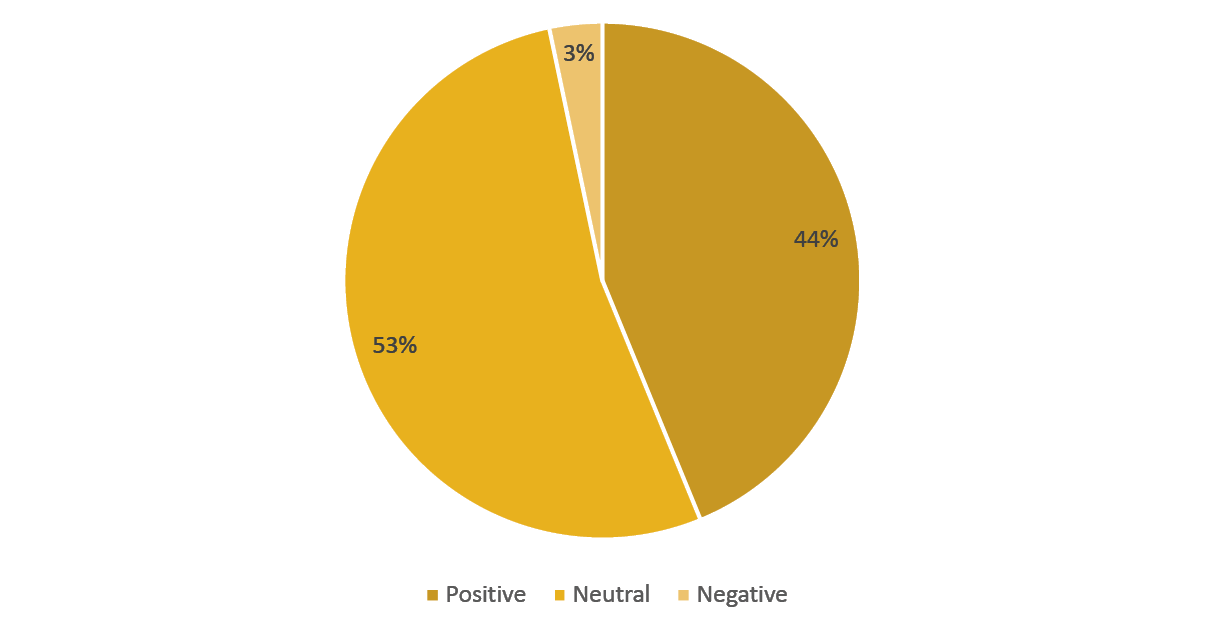
The image of the United States in the Bhutanese newspaper Kuensel is positive or neutral in the vast majority of articles. An analysis of 122 articles in which U.S.-related content appeared confirms this, as shown in the graph below:
Figure 1. Image of the United States in Kuensel
Source: own compilation
This percentage breakdown reflects the theory of Middle Path Journalism, which does not focus on sensationalism, conflict or controversy. Bhutanese journalists very often refer to the U.S. as a model of a properly functioning democracy. In their articles, they sometimes emphasize that the oldest democracy in the world is still functioning. Of course, this claim can be debated, especially in the context of ancient Greece, where democracy was born1 (Dunn, 1994). However, it should be emphasized that, according to the Bhutanese press, the U.S. is considered the cradle of democracy, which is confirmed by the content of one of the analyzed articles: “The oldest democracy, the Unites [sic] States of America, has elected a new President” (Kuensel Online, 2020). Furthermore, in one article, the United States is presented as one of the “most liberal democratic countries like the United States” (Tshering, 2020).
The editors of Kuensel refer to experts from the United States in many articles. This applies to every thematic category of the analyzed texts. In addition to contemporary authorities, such as Land Heflin2, they quote historical figures such as Abraham Lincoln: “After all, true democracy means, as said by Abraham Lincoln, »government of the people, by the people and for the people«” (Tshering, 2018). In addition, one of the journalists of Kuensel emphasized that the story3 he described also appeared on CNN: “The centenarian’s story was also reported by CNN” (Dorji, 2020). Undoubtedly, the reference to one of the largest television stations in the world increased the prominence of the topic – and, by extension, the image of the United States – described in the report.
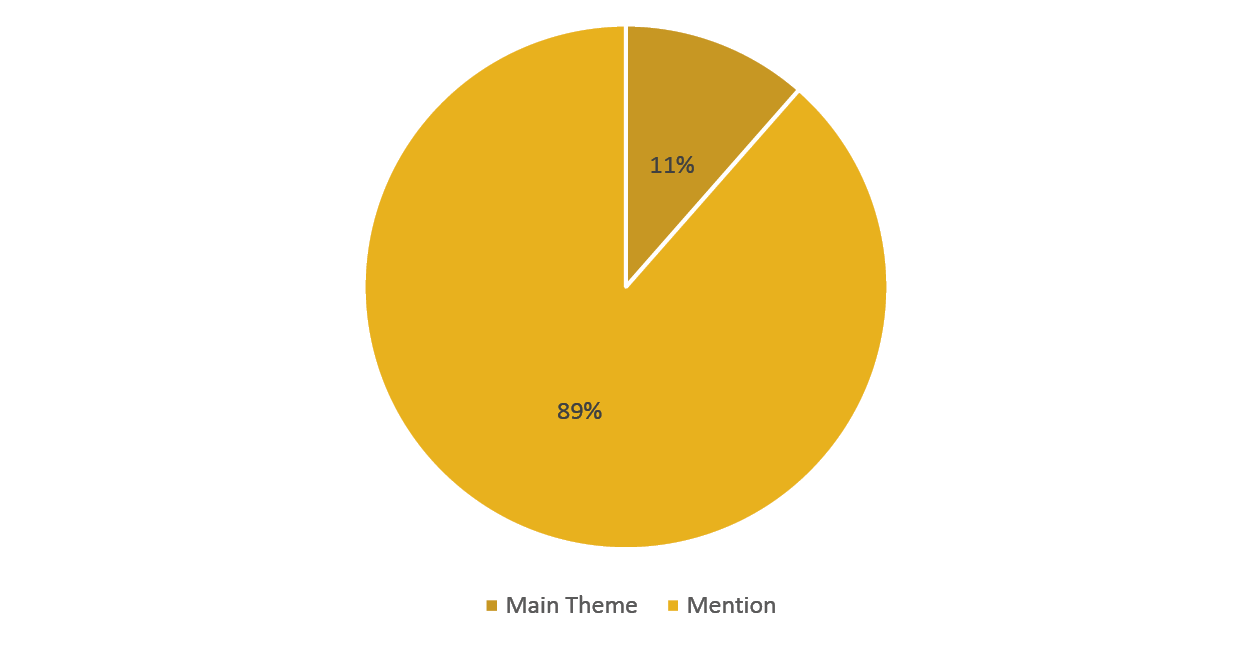
Bhutan’s most popular daily newspaper does not have many articles devoted directly to the United States. In most of the analyzed articles, the topic of the U.S. appears only in passing, often limited to a single sentence. This is frequently the case in articles describing, for example, a UN convention held in New York or another American city. The briefest mentions of the United States are limited to only two words. This is typical of the Middle Path Journalism model, in which the focus is more on individuals than on states or institutions. An example of such a reference can be found, among others, in articles on COVID-19. The first diagnosed case of coronavirus in Bhutan was an American tourist. Many articles in the health category that deal with COVID-19 refer to an “American tourist” who became “patient zero” in this small country. Importantly, this tourist is not portrayed negatively. The content about him is neutral, and he is not described in detail. The chart below shows the percentage of articles in which the United States is the main topic and those in which it is only mentioned.
Figure 2. U.S. presence in Kuensel
Source: own study
An analysis of the frequency of single words in each article also confirms that the United States is not among the main topics of Kuensel. When considering words longer than five letters (not including the term “USA”), the most frequent nouns, adjectives and proper names were: “Bhutan” (550 occurrences), “country” (370), Kuensel (217), “online” (214) and “Bhutanese” (212). Terms related to the United States occurred with the following frequencies: “USA” (74), “American” (49) and “America” (44). Interestingly, even the term “Canada” (32) appeared relatively frequently, even though the research sample contained only articles that included the terms “United States of America”, “United States”, “America” and “USA”. These results are presented more clearly in the table below.
Table 1. Frequency of single words in Kuensel (only nouns, adjectives and proper names; words longer than five letters, except for “USA”)
| Word | Frequency | |
|---|---|---|
| 1. | Bhutan | 550 |
| 2. | country | 370 |
| 3. | Kuensel | 217 |
| 4. | online | 214 |
| 5. | Bhutanese | 212 |
| (…) | (…) | (…) |
| 128. | USA | 74 |
| 164. | American | 49 |
| 172. | America | 44 |
| 226. | Canada | 32 |
Source: own study
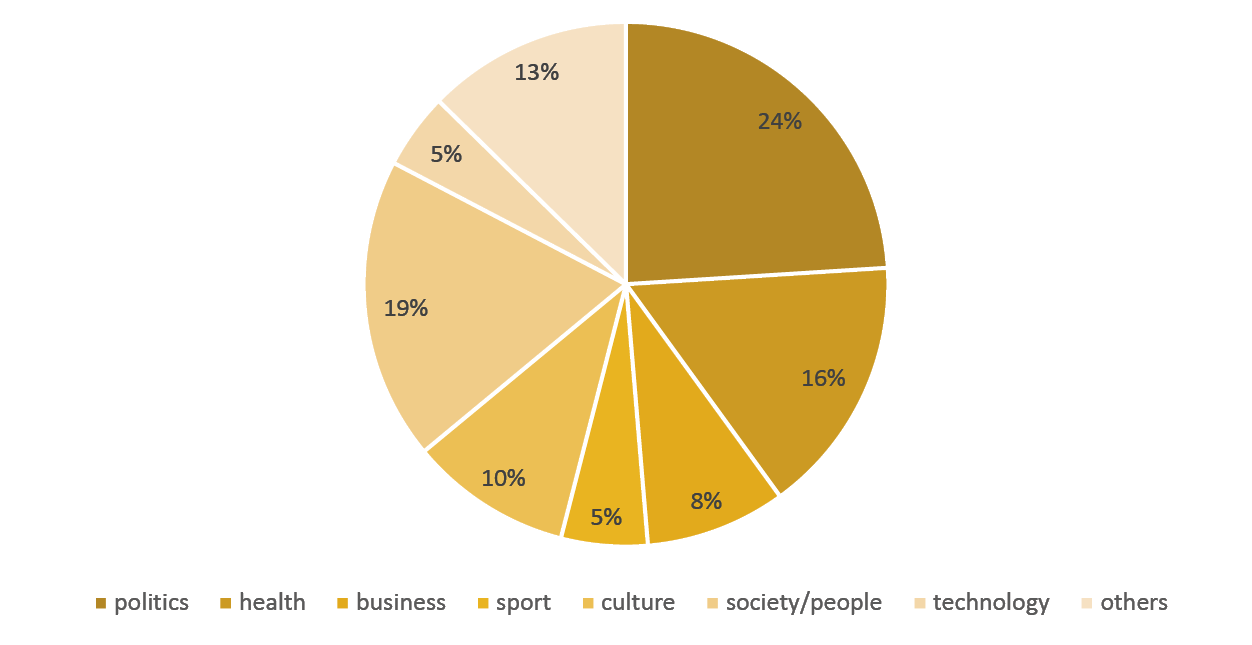
Kuensel is a Bhutanese newspaper that covers different areas of life. During the qualitative content analysis, eight categories were extracted, and each of the studied articles was classified according to its topic. The researchers used the following categories: politics, health, business, sports, society/people, culture, technology and others. The three most frequent categories were politics (24%), society/people (19%) and health (16%). Although politics is the dominant topic, political articles avoid scandals and controversy, in line with the concept of Middle Path Journalism. They focus more on commentary and descriptive accounts of current events on the political scene. The chart below illustrates the percentage distribution of all categories included in the sample.
Figure 3. Topics in Kuensel in the context of writing about the U.S.
Source: own study
In the politics category, most articles are devoted to the politics of Bhutan and other Asian countries. However, there are often references, comparisons or allusions to the United States. The vast majority of them portray the United States in a positive or neutral light. One of the few exceptions is the article “Trust in the 21st Century”, which deals with trust in politicians. Its author, Andrew Sheng, cites a study showing that “the Pew Research Center found that only 17% of Americans today say they can trust the government in Washington” (Sheng, 2020). This quotation casts doubt on the credibility of the U.S. government, which may project a negative image of the United States when the country is viewed through the lens of politics.
In Kuensel, a substantial amount of content is dedicated to human stories and society. Amid news reports and interviews, there is also space for reportage. This is connected to the recurring problem of mistreatment of Bhutanese women in Iraq who went there to work. At first glance, this topic might seem unrelated to the U.S.; however, the opposite is true. In a report describing the situation of Bhutanese women in Iraq, entitled “Escaping the Nightmare”, the author writes: “The situation in Iraq is becoming hostile and with the current tension with the USA, major conflict could break out. Bhutanese there would be affected if they are not brought back home at the earliest possible” (Tshedup, 2020). This is another example of one of the few articles in which the United States can evoke a negative connotation. It is important to note, however, that the accusations in the article are directed only at Iraqis, while Americans appear only as one of the parties to the armed conflict.
The third most common category, health, might not have been classified as a separate category before the COVID-19 pandemic. The emergence of the pandemic increased the number of articles devoted to health. None of the analyzed articles classified in this category portrayed the United States negatively. The presence of the United States in this type of content is limited to mentions, primarily in the context of citing the number of cases worldwide.
The culture category primarily includes articles related to the culture of the broader East. Nevertheless, it is possible to find content that presents the United States as a prestigious center of world culture, especially in cinematography. The title of one article itself indicates the importance of the U.S. in the film industry: “Kushuthara – A Pattern of Love will premiere in the US”. The article reports that a Bhutanese film would premiere in the United States. It suggests that the U.S. is one of the most important film centers in the world: “The film will premiere as a part of the Himalayan Heritage Show. The film will also be released in select movie theatres in San Francisco, Los Angeles (LA) and NYC, with worldwide release on iTunes, Amazon and other Video on Demand platforms and on Netflix” (Zangmo, 2017).
The United States also appears in the business category. Bhutanese authors often refer to the U.S. when writing about domestic businesses. Usually, the U.S. is presented in this context as a financial power with a highly developed economy. In an article on Bhutanese business titled “Fostering competition important”, the anonymous author begins by quoting the words of an American millionaire and author: “Bhutanese manufacturers and businesses could very well have been in the mind of a great American millionaire-author Kiyosaki when he famously declared: »Failure defeats losers, failure inspires winners.« Perhaps we are still a long way from realizing the fact that sensible innovation and relentless marketing are at the heart of any successful business” (Kuensel Online, 2019). This example supports the thesis that Bhutanese authors perceive the U.S. as one of the world’s most important countries in financial and business terms.
Articles assigned to the sports category account for less than 5% of the sample. In Bhutan, the national sport is archery, which is unique in the world; no other country considers archery its national sport. This may partly explain the rare presence of the U.S. in sports articles in Kuensel. The article titled “Coach Mike hands Bhutan first international win” deserves attention. It presents American basketball in a very positive light. The protagonist of the article is Michael Andrew Behnke, the American basketball coach who led Bhutan to its first international win. The American basketball school is considered one of the best in the world, and the sports editor of Kuensel presents it in this way as well. A substantial part of the article positively portrays the American coach as a reformer of Bhutanese basketball. This is evidenced by the following excerpt: “One of Coach Mike’s biggest contributions to the game was the introduction of a system where match statistics are maintained. During the major leagues Coach Mike maintained a record on how many points and rebounds each player made during the game” (Tshedup, 2016). One of the pillars of Middle Path Journalism is community. It is therefore not surprising that Kuensel’s writing on sports contributes to strengthening community and unity, especially when it concerns success on the international stage.
Some articles had to be classified as “others”. This was especially true of texts concerning environmental protection, education, tourism trivia, crime news and various guides. In none of the articles in this category was the United States the main topic. It appeared only as background or as one element of the story. The presence of the U.S. in texts describing drug trafficking could raise image-related concerns. The United States appears there as a potential destination for illegal contraband, but the rhetoric of the text does not indicate that this should influence the perception of the country negatively. In the article “Bangkok drug case nearing end”, the following statement appears: “Sources said the first case was one involving a Bhutanese attempting to smuggle cannabis into the United States of America” (Palden, 2017). The sentence does not clearly indicate a negative image of the U.S., but it should be noted that it may produce negative associations for some recipients.
In addition to clear instances of Bhutanese actors looking to U.S. models in many areas of life, there is also content in Kuensel in which the roles are reversed. In the article “California looking to replicate GNH model of development”, the author writes about the visit to Bhutan of a California State Senate delegation, led by Senator Toni G. Atkins, which came to learn about Gross National Happiness (GNH), the environment, women’s issues and Bhutan’s judiciary. As the article states: “Tandi Dorji of Tara tours and Trek said the delegation was here to learn about GNH and to work out a way to replicate it in California. »They wanted to learn about how it is working in Bhutan and to take back the lessons and implement out there«” (Dorji, 2018). The article suggests that it is prestigious for Bhutan that one of the world’s major powers came to this small country for an educational visit.
Middle Path Journalism in Kuensel’s articles
The most important conclusion that can be drawn from the research is that the United States is presented in a positive tone in Bhutan’s most popular newspaper. The exception to this rule consists of only four articles, which account for 3% of all analyzed texts. It should be emphasized that even in those texts that the authors of the study considered unfavorable to the image of the U.S., no extremely negative content concerning the U.S. was found. This may certainly be influenced by the mission and idea behind the creation of Kuensel. Gross National Happiness (GNH) is also relevant here. On the newspaper’s official website, its creators describe it as follows:
Gross National Happiness is not a promise to make people happy. It is a mandate to serve the people. For Kuensel it means establishing values and setting standards. Our aim is to do this with professionalism. This means not just reporting stories but reflecting on them and writing our stories with, not just objectivity, but with sensitivity. Ultimately happiness lies within the self. The Bhutanese people have to make the right decisions to find happiness. To make the right decisions they need the right information.
The mentality and Buddhist worldview may also account for the very positive image of the United States in Kuensel. According to Judeo-Christian theology, human beings are marked by original sin from birth (Wiley, 2002). Sin is one of the most common motifs in descriptions of human actions in the Bible. At the opposite pole lies the Buddhist worldview, especially Himalayan Buddhism. According to the principles and beliefs of this religion, all sentient beings have Buddha-nature within them and are therefore good from the beginning (Norbu, 2001). This is a fundamental difference between these two powerful religious traditions. It may also be one of the arguments explaining the positive portrayal of the U.S. in Bhutanese media, while media around the world are increasingly moving toward negative messaging (Wangchuk, 2018).
Despite Kuensel’s positive perception of the U.S., it is fair to say that the newspaper contains little content directly about the country whose capital is Washington. The vast majority of the research sample concerned local issues, and the United States often appeared only in passing. This is hardly surprising given the history of Kuensel and its contribution to Bhutan’s political transition. A quotation from the Kuensel Online website is relevant here: “We have presented Bhutan’s image to the world and, more importantly, Kuensel has been a mirror for Bhutan to look at itself”. Thus, one of Kuensel’s most important tasks is to describe events taking place in Bhutan. As a result of globalization, however, it is impossible to write even about a country so distant from Western civilization without referring to countries such as the United States. The appearance of the U.S. in the press of a Buddhist culture is also connected to the high respect for the United States of America that is evident in the analyzed content. While reading the articles, the authors of the study often noticed that American scientists, politicians, athletes or journalists were quoted as experts.
An important goal of the study was to analyze content about the U.S. in terms of the concept of Middle Path Journalism discussed in the introduction. Underlying this model are two key terms: values and vision. Values should be understood as a set of norms or principles of human conduct that shape opinions and judgments about the prioritization of issues in life. Vision, on the other hand, refers to the long-range goal of Bhutanese society as a signpost on the way to achieving a common goal (Wangchuk, 2018). The researcher of Buddhist culture Dorji Wangchuk identifies four main characteristics of this model of journalism: contentment, compassion, community and commitment. Each of these values characterizes Kuensel’s content about the United States.
The first of these features, contentment, seems obvious in the context of the frequently mentioned Gross National Happiness (GNH). Kuensel’s authors generally do not look for sensation in places where crimes or tragedies have occurred. They write mainly about positive issues and interesting human stories. Middle Path Journalism emphasizes framing content in a human-centric way (Wangchuk, 2018). This means telling stories primarily about human beings, who in the Buddhist perspective possess qualities identical to Buddha-nature, rather than about wealth, power, lust, sins, affairs or transgressions. In Wangchuk’s research paper on the concept of Middle Path Journalism, we read:
Middle Path Journalism is diametrically opposite to the corporate media where celebrity gossips are sold; and pictures of politicians opening bridges and hospitals (actually built by ordinary people) flood the screen. The media impact studies in Bhutan have shown that the media contents today arc too capital-centric and elitist. Middle Path Journalism will seek to correct this imbalance.
Given the above description of this model of journalism, it seems fully justified that Kuensel writes about the United States in a positive light. It is likely that any country subjected to a similar analysis would produce comparable results, although this assumption would require further research. This is primarily connected with the value of commitment, which is one of the foundations of the Bhutanese style of journalism. None of the articles analyzed by the authors concerned lust or unwanted or excessive human needs. No clickbait4, controversial or provocative articles were found in Kuensel. Additionally, articles about, for example, the difficult situation of Bhutanese women in Iraq (with some reference to the U.S.) confirm that Kuensel tends to put people at the center of the story. At times, one gets the impression that it is closer to a magazine-style journalistic press than to a purely informational one.
The second premise of Middle Path Journalism is community. In Bhutan, society forms a well-organized community in which families and other social groups direct their work and activities mainly toward the interest of the community (Phuntsho, 2013). In this Himalayan country, failing to care about family or the affairs of the Bhutanese people is considered reprehensible; such a person is not accepted and is viewed as dishonorable. In spiritual and philosophical terms, the greatest respect is given to those who have rendered service through activities such as sponsoring commemorative monuments or religious ceremonies, which, according to the Buddhist worldview, benefit more than just people. In Kuensel, there are articles about Bhutanese people scattered across the world, including in the United States. Much of the analyzed material concerned local holidays, traditions and anniversaries – definitely more than “imported” holidays. None of the texts analyzed featured American holidays such as Halloween, in contrast to many local public holidays. Kuensel’s journalists more often write about local people than about celebrities. In many texts of this type, there is some reference to the U.S., usually a brief mention such as “graduated from college in New York”.
Another feature of Kuensel’s style is compassion. In Buddhist culture, and not only there, it is believed that karma comes back to a person – that is, every bad decision or wrongdoing will one day return to the person who committed it (Wangchuk, 2018). The author of the concept on which this article is based defines compassion in the context of the journalistic model as follows:
The concept of lay-judray assumes a practical form in our daily lives in the form of compassion for all sentient beings. Under the middle path journalism approach, journalist could practice and promote compassion in his or her line of duties by avoiding the extremes while calling for justice and at the same time, healings and forgiveness could be encouraged. The parties could be encouraged and guided to move forward.
The above assumption fits the nature of the content that constructs the image of the United States in the Bhutanese press. It contains no aggressive titles or sentences. The content analyzed by the authors, for example articles about COVID-19, did not incite panic or instill fear – quite the opposite. Patient zero5 (an American tourist) in Bhutan at the time of the COVID-19 pandemic outbreak is not stigmatized or described in a pejorative way. Emotions such as compassion, concern and empathy predominate in the numerous articles in which this topic appears. Examples from other countries, such as Poland, show that such a person can be treated as a culprit. In an interview with the Polish “Patient Zero” for the Polish portal Onet.pl, the interviewee emphasizes that he still feels the effects of the disease. However, he mainly refers to psychological effects, because society criticized him, even using phrases such as “you brought the disease to Poland”. In the content of the Bhutanese Kuensel, this kind of approach seems unrealistic.
CONCLUSION
The biggest difficulty the researchers encountered during the analysis was judging whether the image of the United States in a given article was positive, neutral or negative. Each person’s perception may differ depending on their axiological perspective. Despite these obstacles, it can be stated that the United States is portrayed very favorably in the media of a small Himalayan country such as Bhutan. Although it is not a popular topic in the content of Bhutan’s most popular newspaper, the presence of the U.S. seems important for the development of the Bhutanese community. Drawing on models, imitating practices or hiring American experts – such as a basketball coach for Bhutan’s national team – can significantly influence the development of this resource-constrained, GNH-oriented country.
Middle Path Journalism is based on commitment and requires journalists to be appropriately engaged in their work. This premise obliges the Kuensel team to fulfill the basic functions of journalism: striving for objectivity, seeking the truth and strengthening the national community through articles written for the nation’s most popular newspaper (Christians, Glasser, McQuail, Nordenstreng, & White, 2009). Based on the reading of 122 articles in Kuensel, this pillar of Middle Path Journalism is also applicable to the newspaper. Bhutanese journalists often emphasize the role of their mission, which can be read between the lines of their articles. This also contributes to the very positive image of the U.S. in Kuensel. One of the primary functions of the newspaper is to educate and promote appropriate models, which is reflected in the numerous comparisons between particular issues in Bhutan and the U.S., with the latter often serving as a point of reference.
REFERENCES
Anderson, B. (2006). Imagined communities: Reflections on the origin and spread of nationalism (rev. ed.). Verso.
Avieson, B. (2015a). From mani stones to Twitter: Bhutan creates a unique media matrix for a 21st-century democracy. International Journal of Communication, 9, 2487-2506. https://ijoc.org/index.php/ijoc/article/view/3186
Avieson, B. (2015b). The dragon’s voice: How modern media found Bhutan. University of Queensland Press.
Christians, C. G., Glasser, T. L., McQuail, D., Nordenstreng, K., & White, R. A. (2009). Normative theories of the media: Journalism in democratic societies. University of Illinois Press.
Conlon, C. (2002). Bhutan. In S. A. Gunaratne (Ed.), Handbook of the media in Asia (2nd ed., pp. 67-83). SAGE Publications.
Creswell, J. W. (2013). Research design: Qualitative, quantitative, and mixed methods approaches. SAGE.
Chakravartty, P., & Roy, S. (2023). Questioning “de-Westernization”. Political Communication Report, 28. https://doi.org/10.17169/refubium-41239
Datta-Ray, S. K. (1996). Press freedom and professional standards in Asia. Media Asia, 23(3), 131-133. https://doi.org/10.1080/01296612.1996.11726501
Doliwa, U., & Żyliński, S. (2021). Community radio in Bhutan. Journal of Radio & Audio Media. https://doi.org/10.1080/19376529.2021.1920024
Dorji, K. G. (2015, May 4). Bhutan to expand medical assistance to Nepal. Kuensel. Accessed February 15, 2021. https://kuenselonline.com/bhutan-to-expand-medical-assistance-to-nepal/
Dorji, N. (2018, November 19). California looking to replicate GNH model of development. Kuensel. Accessed February 15, 2021. https://kuenselonline.com/california-looking-to-replicate-gnh-model-of-development/
Dunn, J. (1994). Democracy: The unfinished journey, 508 BC-AD 1993. Oxford University Press.
Emmel, N. (2013). Sampling and choosing cases in qualitative research: A realist approach. SAGE.
Freedom House (2024). Freedom in the World 2024: Bhutan country report. Accessed December 7, 2025. https://freedomhouse.org/country/bhutan/freedom-world/2024
Frampton, B. (2015, September 14). Clickbait: The changing face of online journalism. BBC News. Accessed March 14, 2021. https://www.bbc.com/news/uk-wales-34213693
Gunaratne, S. A., Pearson, M., & Senarath, S. (2017). Mindful journalism and news ethics in the digital era: A Buddhist approach. Routledge.
Hampton, M. (2010). The Fourth Estate ideal in journalism history. In S. Allan (Ed.), The Routledge companion to news and journalism. Routledge.
Hallin, D. C., & Mancini, P. (2004). Comparing media systems: Three models of media and politics. Cambridge University Press.
He, Z., Chen, X., & Xing, W. (2012). The image of the United States in the Chinese media: An examination of the evaluative component of framing. Public Relations Review, 38(5), 676-683. https://doi.org/10.1016/j.pubrev.2012.09.001
Josephi, B. (2017). Journalists for a young democracy. Journalism Studies, 18(4), 495-510. https://doi.org/10.1080/1461670X.2015.1065199
Kinley, D. (1991). The media in Bhutan. In Consultation on Press Systems in SAARC: Kathmandu, Nepal, 2-5 April 1991. Asian Mass Communication Research & Information Centre. https://hdl.handle.net/10356/93133
Kuensel Online. (2019, February 27). Fostering competition important. Kuensel. Accessed February 15, 2021. https://kuenselonline.com/fostering-competition-important/
Kuensel Online. (2020, November 9). The road to winning Chhoekhor-Tang. Kuensel. Accessed February 15, 2021. https://kuenselonline.com/the-road-to-winning-chhoekhor-tang/
Kuensel Online. (2025). About us. Accessed December 7, 2025. https://kuenselonline.com/about-us
McLuhan, M., & Lapham, L. H. (1994). Understanding media: The extensions of man (reprint ed.). MIT Press.
Mitchell, J. C. (1984). Typicality and the case study. In R. Ellen (Ed.), Ethnographic research: A guide to general conduct (pp. 237-241). Academic Press.
Muppidi, S. (2012). Bhutan (.bt). In S. R. Muppidi (Ed.), Asian communication handbook (6th ed., pp. 172-184). Asian Media Information and Communication Centre and Wee Kim Wee School of Communication and Information, Nanyang Technological University.
Norbu, T. (2001). White sail: Crossing the waves of ocean mind to the serene continent of the triple gems. Shambhala Publications.
Palden, T. (2017, January 14). Bangkok drug case nearing end. Kuensel. Accessed February 15, 2021. https://kuenselonline.com/bangkok-drug-case-nearing-end/
Park, M. J., & Curran, J. (Eds.). (2000). De-Westernizing media studies. Routledge.
Phuntsho, K. (2013). The history of Bhutan. Random House India.
Rapten, P. (2001). Mass media: Its consumption and impact on residents of Thimphu and rural areas. Journal of Bhutan Studies, 3, 3-12.
Reporters Without Borders. (2025). Bhutan. Accessed December 7, 2025. https://rsf.org/en/country/bhutan
Sharma, C. S. (2007). Bhutanese folktales: Common man’s media with missions for society. Journal of Bhutan Studies, 17, 83-112.
Shaw, B. (2012). Bhutan. In J. Love (Ed.), South Asia 2013 (10th ed., pp. 201-237). Routledge.
Sheng, A. (2020, March 2). Trust in the 21st century. Kuensel. Accessed February 15, 2021. https://kuenselonline.com/trust-in-the-21st-century/
Siebert, F. S., Peterson, T., & Schramm, W. (1956). Four theories of the press: The authoritarian, libertarian, social responsibility, and Soviet communist concepts of what the press should be and do. University of Illinois Press.
Tshedup, Y. (2016, April 9). Coach Mike hands Bhutan first international win. Kuensel. Accessed February 15, 2021. https://kuenselonline.com/coach-mike-hands-bhutan-first-international-win/
Tshedup, Y. (2020, January 11). Escaping the nightmare. Kuensel. Accessed February 15, 2021. https://kuenselonline.com/escaping-the-nightmare/
Tshering, S. (2018, September 1). Balancing the right to vote and being apolitical. Kuensel. Accessed February 15, 2021. https://kuenselonline.com/balancing-the-right-to-vote-and-being-apolitical/
Tshering, S. (2020, December 26). Ensuring the right to information to fight rumours and fake news. Kuensel. Accessed February 15, 2021. https://kuenselonline.com/ensuring-the-right-to-information-to-fight-rumours-and-fake-news/
Ura, K., Alkire, S., & Zangmo, T. (2012). GNH and GNH index. Centre for Bhutan Studies.
Wangchuk, D. (2018). Middle path journalism: A conceptual framework for Bhutanese media. In K. Seneviratne (Ed.), Mindful communication for sustainable development: Perspectives from Asia (pp. 133-150). SAGE. https://doi.org/10.4135/9789353280697.n12
Wiley, T. (2002). Original sin: Origins, developments, contemporary meanings. Paulist Press.
Wood, P. (2007). Priming the printing press: The growing print media in Bhutan. S.I.T. Tibetan and Himalayan Studies.
Zangmo, T. (2017, January 23). Kushuthara – A Pattern of Love will premiere in the US. Kuensel. Accessed February 15, 2021. https://kuenselonline.com/kushuthara-a-pattern-of-love-will-premiere-in-the-us/
Żyliński, S. (2016). Bhutan media system – an attempt of preliminary analysis. Zeszyty Prasoznawcze, 59(4), 674-689. https://doi.org/10.4467/22996362PZ.16.042.5917
1 The term democracy first appeared in ancient Greek political and philosophical thought in the city-state of Athens during classical antiquity.
2 Land Heflin is a Mississippi born, second-generation river guide, and has spent his life on or near rivers. His graceful paddling and intuitive river sense are products of a life spent on the water. A veteran instructor who has taught at kayak schools throughout the US.
3 The story about The Bhutanese medical team which treated a 101-year old man, who was rescued from under the rubble of his home in Nuwakot (Bhutanese city), one week after the earthquake. He is in a stable condition currently.
4 Clickbait is a text or a thumbnail link that is designed to attract attention and to entice users to follow that link and read, view, or listen to the linked piece of online content, with a defining characteristic of being deceptive, typically sensationalized or misleading (Frampton 2015).
5 Patient Zero is the first documented patient in a disease epidemic within a population.